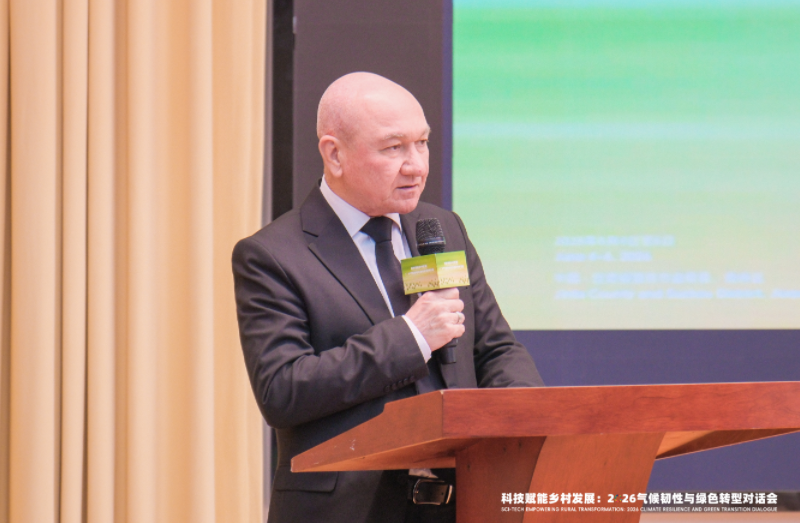
On the sidelines of the "Sci-Tech Empowering Rural Transformation: 2026 Climate Resilience and Green Transition Dialogue," held in China's northwestern Gansu Province, Mr. Charymuhammet Shallyyev, Director of the Central Asia Regional Economic Cooperation (CAREC) Institute, sat down with China.org.cn to discuss how China's digital ecological governance model can serve as a blueprint for Central Asia and the Global South.
Mr. Shallyyev highlighted the transformative potential of China's space-air-ground integrated digital system, which combines satellite remote sensing, big data analytics, and intelligent algorithms to support refined and regular ecological governance. "The model greatly improves the comprehensive management of ecological problems such as desertification, drought, and sandstorms," he said. "And as we know, China has very unique experience in ecological and at the same time economic and social lives."
He emphasized that this system is not only proven but also highly transferable. "Developed through long-term practical application in China, an AI and big data-driven digital ecological governance system is highly practical and readily transferable."
He identified three key strengths of the model: first, it enables precise, proactive ecological risk management by building full-coverage, real-time monitoring networks; second, it delivers fully validated technical solutions, including drone-based afforestation and intelligent water conservation systems; and third, it provides a low-cost, replicable blueprint for developing countries. "Unlike high-end, expensive technological solutions that only apply to limited scenarios, this data-centric smart governance model aligns well with the institutional capacities and development realities of developing countries," he noted.
Turning to regional cooperation, Mr. Shallyyev stressed the strong complementarity between China and Central Asian countries. "Through decades of on-the-ground practice, Xinjiang and Gansu in western China have developed a full set of proven, scalable, and cost-effective solutions for dryland ecological management. This covers oasis sand stabilization, saline-alkali restoration, water-saving drip irrigation, and the cultivation of drought and salt-tolerant crop varieties — practices that fit perfectly with Central Asian natural conditions."
He outlined three core areas where the CAREC Institute serves as a bridge for regional cooperation. First, facilitating two-way knowledge sharing. "Over the past two years, we have received continuous requests from member countries to organize study tours for learning Chinese practical water governance and smart agriculture practices." Second, conducting tailored capacity building through specialized training courses for local technicians and government officials. Third, informing policy dialogue through evidence-based research that supports multilateral exchanges and helps build consensus on climate adaptation and green agriculture.
Regarding the "ecological + industry" model demonstrated in Gansu, Mr. Shallyyev described it as highly suitable for Central Asia. "Rather than investing in desert management with little economic return, this mode unlocks the potential of desert land resources. It achieves balanced development by combining ecological restoration with local specialty industries." He noted that Central Asia shares similar climatic and terrain conditions with northwest China, with large desert and saline areas and rich native desert plant resources.
However, he cautioned against direct copying. "The region still faces real constraints, including limited funding, a lack of professional talent in mature desert industry technologies, fragmented land rights, and a large gap between water supply and demand." He recommended a gradual, step-by-step approach: starting with small-scale pilots in typical areas such as the Aral Sea region, then integrating land resources through local cooperatives and bringing in external investment, and finally adjusting the model to fit local institutions and conditions.
Looking ahead, Mr. Shallyyev expressed strong optimism about China-Central Asia cooperation on climate governance. "Both sides face common environmental problems such as desertification, water scarcity, and glacial melting. This shared situation lays a solid foundation for joint green development efforts." He confirmed that the CAREC Institute will continue leveraging platforms such as the Tianshan Forum to help Global South countries strengthen climate resilience through research, capacity building, and knowledge sharing, guided by the principles of the Sustainable Development Goals, the Belt and Road Initiative, and South-South cooperation.