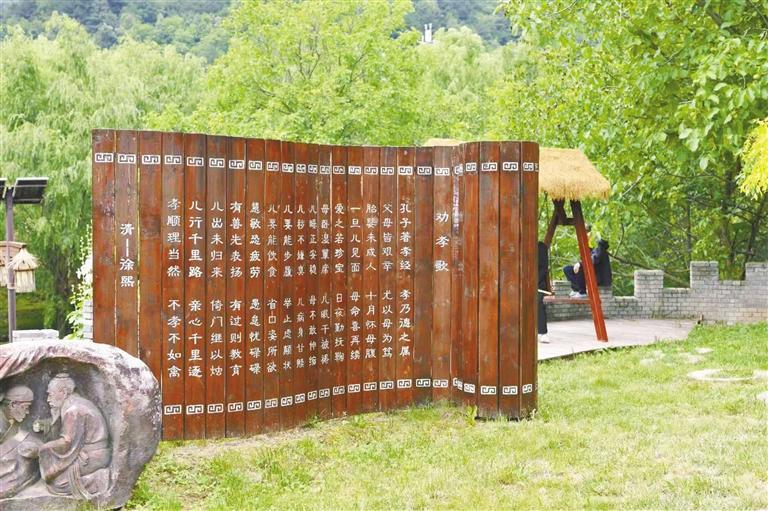
A view of a poem written by Xu Xi, a tribute student who was active during the late Qing Dynasty (1644 to 1912), known as “A Song Encouraging Filial Piety” painted on pieces of wood in Baiyun village, Jutou town, Taibai county, Shaanxi province. Meticulous efforts have been made to enhance the environment, highlight the artistry, and enable visitors to enjoy the idyllic pastoral lifestyle that exists in the hamlet in recent years. [Photo by Zhang Siyu / Shaanxi Daily]
In recent years, northwest China’s Shaanxi Province has been reimagining rural courtyards as spaces of economic opportunity. Focusing on women and building on the 440,000 exemplary “beautiful courtyards” – commendable spaces that emerged after an initial project of the same name entailing enhancement of the living environment in the area’s villages and efforts to beautify their courtyards was implemented – and 2,754 model villages that have excelled with regard to the five main aspects of the project, i.e., public participation, management systems, residence environments, rural culture and customs, and infrastructure, that now exist, the area launched an undertaking known as the Courtyard Plus initiative in order to harness the latent economic power of its rural courtyards, help women living in its villages and their families increase their incomes, and contribute to the vitalization of rural areas in a green and sustainable manner.
Boutique guest houses appear in ‘beautiful courtyards’
Baiyun village, Jutou town, Taibai county, offers a vivid example. Nestled among green mountains and clear streams, the hamlet began pursuing agritourism in 2016. The family-run inns that were established quickly became popular, and many of the people who operate them began upgrading them into boutique guest houses equipped with heated floors, refrigerators, and purified water – modern comforts that still preserve the village’s rustic charm – in 2020.
“Every year, we start experiencing a lot of demand in April, and by July and August – our peak season – it’s nearly impossible to get a room,” Qi Yongli, Baiyun village committee director, noted in June.
“Room and meal prices are clearly posted in order to ensure fairness, prevent arbitrary price hikes in July and August, and increase visitors’ satisfaction,” Qi continued.
Supported by organizations such as the local Women’s Federation, a branch of the All-China Women’s Federation – an organization that is responsible for promoting government policies pertaining to women and promoting the overall status and welfare of women in Chinese society – over 100 women in Baiyun have received training that has enabled them to become professional guest house managers. In 2024 alone, the village logged 20,000 visits and generated 2.05 million yuan (US$287,820) in tourism revenue. The hamlet’s “beautiful courtyards” have thus given rise to a beautiful economy.
Ecological farming: turning courtyards into banks of wealth
In Sihao village, Taiyigong sub-district, Chang’an district, Xi’an city, the capital of Shaanxi province, courtyards bloom with flowers as well as opportunity. In 2024, the hamlet adopted a development model involving “a company + a cooperative + local farmers” and partnered with an enterprise based in the area that engages in ecological agriculture – a type of farming that combines modern science and innovation with respect for nature and biodiversity. The company supplies seedlings and training, Sihao’s cooperative coordinates production, and the farmers that are involved are guaranteed 80 yuan (US$11.23) per pot for the flowers they grow.
“Around the end of the year, the company that we work with will buy all of my orchids, and I will earn more than 3,000 yuan (US$421),” Sihao resident He Xiaoli mentioned in June while proudly tending her 40 boat orchid (Cymbidium) pots, which is twice as many as what she had in 2024.
Over 200 households, or more than 75% of the families in Sihao, were engaged in orchid fostering and were managing more than 10,000 pots in total as of late June, and the village’s cooperative is expected to generate 70,000 to 80,000 yuan (US$9,828 to US$11,232) of revenue this year. The closed-loop “orchid farming + courtyard fostering” model that has been employed has been emerging as a replicable pathway to rural prosperity.
Courtyard Plus education: a new classroom for students
The traditional courtyards that exist in Shenyu village, Baimatan town, Huanglong county, Yan’an city, have been transforming into vibrant classrooms that weave culture, ecology, and education together. Students can immerse themselves in local heritage – pounding the Huanglong Hunting Drum (a special drum used in a corresponding dynamic plaza art form that fuses percussion with dance) and dancing along to the rhythms played on it, harvesting honey using traditional methods, making auspicious hundred-family patchwork quilts (a style of northern Chinese patchwork in which one hundred families each contribute a block in order to impart blessings of good fortune for a newborn child or a soon-to-be-married couple at their wedding) by hand, cooking a variety of flower-shaped buns, and painting on stones found in the area.
“We designed a curriculum that integrates Chinese culture, intangible cultural heritage, green leisure activities and agricultural practices,” Shenyu Party Secretary Xue Zengwen explained in late June. “Children connect with nature and gain knowledge and life skills, while the village embarks on a path of sustainable development.”
From boutique guest houses to orchid banks and cultural classrooms, Shaanxi’s Courtyard Plus project has unlocked the hidden potential of village homes. The initiative has turned their courtyards into gardens of income and creativity for women and children – laying a foundation for long-term rural vitalization.
“Our goal is to imbue the province’s ‘beautiful courtyards’ with additional connotations and ensure that they become lasting sources of happiness and prosperity for rural families,” Zhang Xiaoyan, vice-chair of the Shaanxi Women’s Federation, concluded.