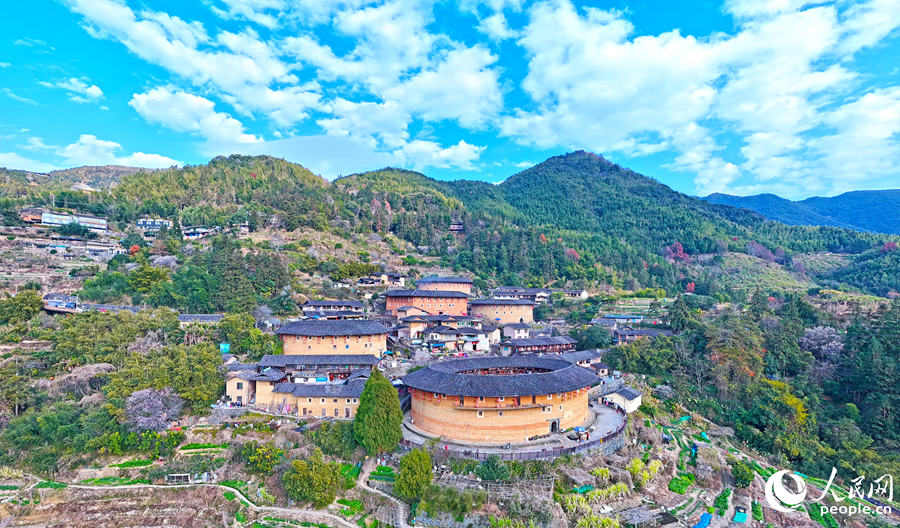
Photo shows the Tianluokeng Tulou Cluster in Nanjing county, Zhangzhou city, southeast China's Fujian Province. (People's Daily Online/Li Changqian)
As the Spring Festival, or Chinese New Year, approaches, the ancient Fujian Tulou, or traditional earthen houses, in Nanjing county, Zhangzhou city, southeast China's Fujian Province, are coming alive with an ever-growing festive atmosphere.
The Tianluokeng Tulou Cluster, comprising five large earthen houses nestled on the slopes of the mountains, is a popular tourist spot. From above, the cluster is said to resemble a traditional Chinese meal of "four dishes and one soup."
Zhencheng Tulou, an earthen house located in Yongding district, Longyan city, Fujian, is often referred to as the "prince of Tulou." Its intricate design, which blends both Chinese and Western architectural elements, along with its stunning wall paintings, reflects a harmonious philosophy that views the diverse group of residents living there as a small society.
Fujian Tulou originated during the Song Dynasty (960-1279) and the Yuan Dynasty (1271-1368) and are primarily found in the southwestern part of Fujian. Renowned for their intricate craftsmanship, the Tulou feature unique construction techniques that integrate defense, fire and theft prevention, ventilation, natural lighting, and comfortable living. In 2008, Fujian Tulou were officially inscribed on the UNESCO World Heritage List.