In the terraced fields in Honghe Hani and Yi Autonomous Prefecture, Yunnan Province, southwest China’s Yunnan Province, the morning mist drifts up from the valleys while the tiered ridges spread like the fingerprints of the earth.
For Min Qingwen, a member of the National Committee of the Chinese People’s Political Consultative Conference and a researcher at the Institute of Geographic Sciences and Natural Resources Research under the Chinese Academy of Sciences, it is more than a landscape carved by the hands of his ancestors—it is a living testament to ecological wisdom and a vision of harmony between humanity and nature.
In 2002, the Food and Agriculture Organization of the United Nations (FAO) launched the Globally Important Agricultural Heritage Systems (GIAHS) program. It defines the concept as unique land-use systems and agricultural landscapes shaped by the long-term coevolution and dynamic adaptation of rural communities and their environment. These systems not only harbor rich biodiversity but also sustain the social, economic, and cultural needs of local communities, offering a model that supports regional sustainable development.
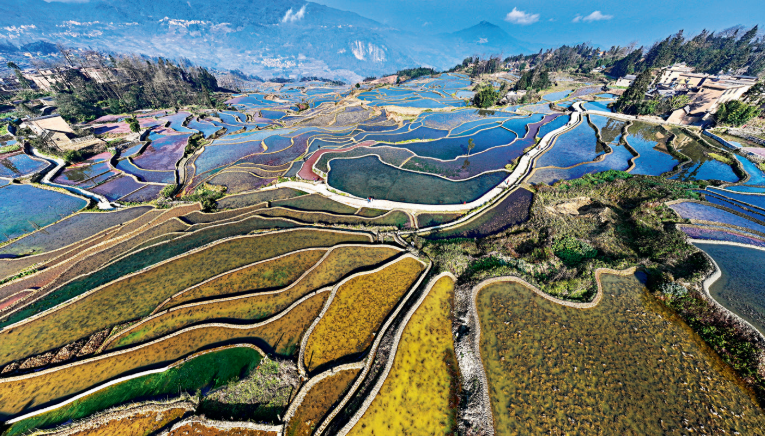
The Hani terraced fields in Yuanyang County, Honghe Hani and Yi Autonomous Prefecture, Yunnan Province, unfolds in vibrant colors under drifting mist, presenting a scene of breathtaking beauty. (CHEN XIANLIN)
In 2025, three new sites in China were added to the GIAHS list. The FAO officially recognized the Deqing Freshwater Pearl Mussels Composite Fishery System in Zhejiang Province, the Fuding White Tea Culture System in Fujian Province, and the Gaolan Shichuan Ancient Pear Orchard System in Gansu Province as GIAHS sites.
China was one of the earliest responders to the GIAHS. It has been proactively participating in the program, offering steadfast support for its promotion. Both a successful practitioner and a major contributor to the GIAHS, China tops its list with 25 designated sites. Through innovations in institutional frameworks, advances in scientific research, and concrete conservation practices, China is contributing greatly to the protection of agricultural heritage worldwide.
Tapping Agricultural Civilizations
In the 1960s and 70s, the steep cost of relentless economic growth started to become evident. Overuse of resources, ecosystem degradation, sharp declines in biodiversity, and the erosion of traditional cultures have prompted a reassessment of the relationship between development and the natural world.
“That is why we must seek solutions from traditional farming wisdom,” said Min.
China has hosted a farming civilization spanning over ten thousand years. Generations of Chinese people have created and continually refined agricultural systems leveraging biological resources, farming techniques, folk customs, ecological knowledge, and cultivated landscapes—systems that remain extraordinarily valuable to this day.
According to Min, most agricultural heritage sites are located in key ecological zones where biodiversity is abundant and ecosystem services are particularly prominent. Traditional agricultural systems demonstrate particularly remarkable adaptability and resilience when challenged by climate change problems, and the traditional knowledge and techniques they embody offer valuable reference for modern ecological agriculture.
One example is the Rice-Fish Culture system in Qingtian County, Zhejiang Province. With a history of over 1,300 years, the system promotes mutual benefits between fish and rice, reducing the use of pesticides and chemical fertilizers while enhancing the ecological functions of the paddies.
The Hani Rice Terraces located in the Honghe Hani and Yi Autonomous Prefecture, Yunnan Province, serve not only as an important grain-producing base but also attract international attention for their role in soil and water conservation and biodiversity preservation.
The Shexian Dryland Stone Terraced System in Hebei Province has cultivated a rich variety of locally maintained crop species, including 68 varieties across 15 types of coarse grains, 58 varieties across 28 types of fruits and vegetables, and 40 varieties of dried and fresh fruits, as well as 15 species of edible fungi, 45 edible wild vegetables, 72 wild medicinal plants, and 32 medicinal animals—forming a valuable gene pool for modern breeding and food security.
Furthermore, agricultural heritage serves as a concentrated repository of rural culture. Rituals, festivals, customs, and mutual support and collaboration all carry the wisdom of village governance and cultural identity. In Qingtian County, the Fish Lantern Dance performed during major festivals has been recognized as a national intangible cultural heritage. Even more prominent on the global stage, the Grand Song of the Dong ethnic group, cherished within the Rice-Fish-Duck system in Congjiang County of Qiandongnan Miao and Dong Autonomous Prefecture, Guizhou Province, has been inscribed as a UNESCO Intangible Cultural Heritage.
Agricultural heritage, a form of “living heritage,” not only preserves the history of agricultural development but offers guidance for a sustainable future. Each site serves as a vital repository of biological, cultural, and technological knowledge.
“Protecting agricultural heritage is, in essence, safeguarding the wisdom of harmonious coexistence between humanity and nature,” opined Min.
China’s Efforts in GIAHS
In 2005, China’s first GIAHS project, the Qingtian Rice Fish Culture System in Zhejiang, was officially designated, marking the launch of China’s efforts in GIAHS.
Over the past two decades, China has gradually forged a model for safeguarding and developing agricultural heritage, one that is led by the government, supported by science, driven by enterprises, centered on farmers, and serving multiple stakeholders.
Beyond topping the world in the number of GIAHS sites, the Ministry of Agriculture and Rural Affairs has also designated 188 sites as China’s Nationally Important Agricultural Heritage Systems (NIAHS). Meanwhile, the ministry established a tiered system including a GIAHS tentative list and a national catalog of NIAHS.
Amid global ecological crises and mounting challenges hindering rural development, protection of agricultural heritage has become a key lever for advancing comprehensive rural revitalization and the construction of a beautiful countryside.
The Chinese government has rolled out a series of policies and established expert committees to provide comprehensive support—policy, financial, and technical—for identification and protection of agricultural heritage. In 2015, Measures for the Administration of Important Agricultural Heritage was issued. Since 2016, protection of agricultural heritage has been a recurring feature in the country’s annual “No. 1 Central Document,” and in 2021 it was formally incorporated into the Law of the People’s Republic of China on the Promotion of Rural Revitalization.
A multidisciplinary research team has been established to provide strong scientific and technological backing for conservation.
By building brands and opening up markets, enterprises have expanded the functions of agriculture, enhancing the value of farm products and fostering integration of agriculture, culture, and tourism.
Through involvement in conservation and development, farmers shifted from producers of crops to guardians and promoters of agricultural heritage, raising their incomes and strengthening their cultural confidence.
“This joint effort has taken heritage protection off the page and into the field, creating lasting momentum for sustainable development,” said Min.
China also places strong emphasis on interdisciplinary collaboration and the training of young talent. More and more scholars and young professionals from fields such as agriculture, ecology, economics, culture, tourism, and management are engaging in conservation research and practices related to agricultural heritage, fostering deep integration of scientific research, public outreach, and protection. More than half of the world’s related academic publications have been authored by Chinese scholars, offering a “Chinese solution” with valuable insights for other countries.
At the same time, China has actively advanced international cooperation through platforms such as South-South cooperation, the Belt and Road Initiative (BRI), and the Conference of East Asia Research Association for Agricultural Heritage Systems (ERAHS), sharing its agricultural wisdom and heritage conservation experience with the world.
Despite the remarkable progress, the protection of agricultural cultural heritage still faces various challenges. Rapid urbanization, climate change, and shifting consumption patterns have worsened issues such as rural depopulation, interruption of traditional cultural transmission, growing ecological pressure, and fluctuating market demand.
Efforts to safeguard and pass on agricultural heritage often involve a wide range of government departments and non-governmental organizations, where overlapping jurisdictions and responsibilities across different levels can lead to duplication or fragmentation. As Min emphasized, “Agricultural cultural heritage is a composite system, and its protection is a complex undertaking that requires comprehensive yet coordinated participation and efforts.”
Dynamic Protection
Agricultural heritage is a “living fossil” of farming civilization. It features elements of both natural and intangible heritage while serving multiple economic, ecological, and cultural functions. Agricultural heritage cannot be confined within a museum for preservation, nor can it be left to gradually vanish under the pressures of modernization. Therefore, protecting it demands unique and tailored approaches.
“Agricultural heritage is best understood not as a relic, but as something still developing and evolving with the times,” Min added. “It is a living system—constantly adapting, deeply rooted in nature, and still central to the food and livelihoods of local communities.”
With a history stretching back over 1,300 years, the Honghe Hani Rice Terraces are anything but static. The terraces today differ from those of a thousand years ago after generations of local residents reshaped them in response to changes in climate, technology, and markets. They are the living result of continuous adaptation across centuries—a process that remains ongoing.
“Changes that could be seen as damage through a lens of conventional relic protection, such as moderate shifts in land use or in varieties of crops and livestock, are in fact vital for agricultural development and for the dynamic preservation of a ‘living’ heritage,” explained Min.
He therefore advanced the idea of “dynamic conservation”: keeping the core zones of the terraces largely traditional while allowing the surrounding areas a measure of adaptation. Min advocates bringing in new varieties and technologies to meet the challenges of climate and markets, yet safeguarding traditional ones as reservoirs of genetic wealth. Meanwhile, the “dynamic conversation” allows room for ventures such as rural tourism, but never at the cost of the underlying ecosystems.
Min stressed that conservation must follow the logic of the land itself—drawing strength from local resources and geography and seeking pathways that fit different types of heritage, ecological landscapes, and stages of development. This is the only way for ecology, economy, and culture to move forward in harmony.
The rice-fish culture in Qingtian County, Zhejiang Province, established an innovative ecological mechanism in which fish living in the paddies fertilize the fields and control pests while the rice provides food and shelter—giving the same acre of land abundant harvests and significant income for local families.
The Longsheng Longji Terraces in Guangxi Zhuang Autonomous Region have developed an innovative approach called “One Field, Five Sources of Income,” which empowers farmers to profit through dividends, conservation bonuses, lease payments, wages from field labor, and tourism—an integrated model of multi-layered benefits.
Based on the Mulberry-dyke & Fish-pond System in Huzhou, Zhejiang Province, the authorities introduced an educational initiative known as “Fish and Mulberry Study Houses.” Local farm households host children for hands-on experiences such as mulberry picking, fishing, and making shell art, immersing participants in the region’s traditional fish-and-mulberry culture.
These examples show that true conservation transcends preservation on paper—it means keeping traditional agricultural systems in operation and empowering them to thrive in the modern era.
“Preservation should occur alongside exploration, and tradition should be passed on through practical use.” Min Qingwen emphasizes that when protecting agricultural heritage, ecology, economy, and culture are inseparable and form a mutually reinforcing whole.
Protection of agricultural heritage is, at its core, a leap in how traditional farming culture is understood. Future society must live in harmony with nature and with each other—and agricultural heritage offers valuable lessons for this vision.
After two decades of exploration, China has contributed a distinctive solution to the world for protecting agricultural heritage. From ecological and cultural strengths to thriving industries, and from industrial growth to rural revitalization, China is charting a path upon which dynamic conservation of agricultural heritage and sustainable development go hand in hand.