French photographer Yann Layma first captured a moment at the Honghe Hani Rice Terraces in 1993. The tiered fields climbed like stairways into the sky. Glints of water appeared and disappeared through drifting clouds. Hani farmers could be seen quietly tending the land. Deeply moved, Layma spent six months producing Mountain Sculptors—a collection that included a film, a photo album, a travel diary, and nearly 10,000 photographs. His works brought the terraces—once secluded deep in the Ailao Mountains—into the international spotlight.
Three decades on, this living heritage spans more than 53,000 hectares across Yuanyang, Honghe, Luchun, and Jinping counties in south China’s Yunnan Province. On September 10, 2025, the Honghe Hani Rice Terraces were added to the World Irrigation Heritage list, joining their earlier designations as a UNESCO World Heritage site and a Globally Important Agricultural Heritage System. This rare triple heritage status has made the terraces a global symbol of agricultural civilization.
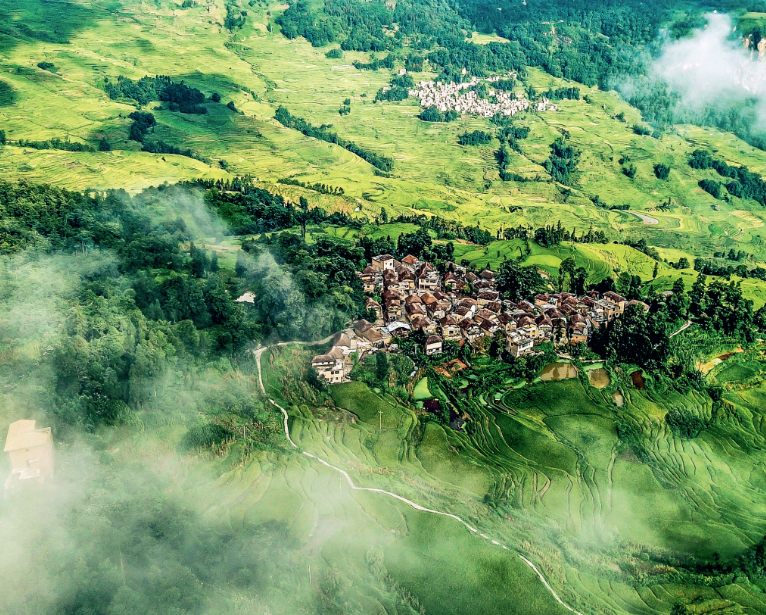
Azhike Village, Yuanyang County. (Rural Revitalization Bureau of Honghe Prefecture)
Over time, the terraces have come to represent more than just scenic beauty. They now serve as a model of how ecological conservation, cultural heritage, and economic revitalization can advance together. From capturing global attention to inspiring sustainable practices worldwide, the Honghe Hani Rice Terraces have charted a distinctive path toward sustainability.
Harmony with Nature
Over 1,300 years ago, the Hani people migrated to the Ailao Mountains and settled there. Generations of meticulous farmers carved out miles upon miles of terraces into the mountainsides, creating a remarkable agricultural system. This system integrates four elements in perfect harmony: forests crown the peaks, villages huddle in the middle, terraces spread below, and streams weave through them all.
Filmmaker Deng Bin recalled the moment he was inspired to document this wisdom. In 2014, while watching drone footage, he witnessed how the irrigation channels reached the highest terraces—and only then did he truly grasp a line from an ancient Hani song:“The higher the mountain, the higher the water climbs.” That was when he began to consider making a documentary. “I wanted the world to see how this farming wisdom brings the land to life,” he said.
To irrigate the terraces, the Hani devised a carved-wood water allocation system, placing wooden gauges at channel forks to measure and distribute water precisely. This system—known locally as “carved-wood water allocation”—ensures efficient irrigation while maintaining ecological balance.
Resources are shared in other ways too. Draft cattle are rotated between the lowlands and the mountains. In spring, Dai and Zhuang families in the river valleys raise and use the cattle for sowing and transplanting. In summer and autumn, Hani and Yi families in the uplands take over plowing and transplanting in the terraced paddies. In winter, as grass withers in the highlands, the cattle return to the warmer valley bottoms. If a calf is born, both sides co-own it. This cooperative arrangement—known as Niujiaqin (Cattle Kinship)—features inter-ethnic collaboration, complementary use of resources, and ecological adaptation.
Culture also thrives in the area. At the traditional Long Street Banquet, Hani, Yi, and Miao communities gather to share red rice and terrace-raised fish and duck, while drum dances and mountain songs highlight cultural diversity. The Palm-Leaf Fan Dance, a national intangible cultural heritage, mimics the movements of the silver pheasant, expressing reverence for nature. Ancient songs like “Rice-Planting Song” and “Four-Season Work Tune” have preserved farming knowledge across generations.
As Deng Bin wrote in his documentary Homeland on the Horizon: “The movements of living creatures stir the urge to dance, and the calls of animals make one burst into song.” In Hani life, people and nature have always been intertwined.
Reviving Ancient Wisdom
Amid a global call to rebuild ecological civilization, the Hani people have preserved a living example of harmony between people and nature. Increasingly, individuals are working to safeguard and renew this heritage.
Wu Zhiming, founder of Honghe County Ethnic Cultural Transmission Center, collects endangered folk songs and teaches traditional instruments like the sanxian and bawu while promoting innovations in polyphonic singing. Chen Lachou compiles story collections to spread Hani culture more widely. Zhang Zhiliang, a returnee youth who became a village cadre, has conducted extensive fieldwork and published studies on Hani attire, festivals, and rituals. He also founded the Zhuixiang (Chasing the Homeland) team, which uses WeChat and community events to bring local culture into the cities. Thanks to such efforts, traditional culture is finding new life.
Since 2017, the China Foundation for Rural Development (CFRD) has advanced the principle of “conservation first, industry as the foundation, culture as the soul.” In concert with local governments and enterprises, it established the Hani Terraces Conservation and Inheritance School, curated farming exhibitions and field-study courses, and created new cultural platforms ranging from harvest concerts to charity sales. Red-rice packaging now features embroidery and totem motifs, turning produce into symbolic gifts. “Here, culture is no longer a static emblem—it now drives rural revitalization,” said Zhang Zitao, project leader at CFRD.
“True conservation lies in keeping traditional wisdom alive within today’s production systems,” added Deng Bin. This enduring approach explains how the terraces have evolved continuously for 1,300 years.
Prosperity with Ecology
The steep terrain of the Ailao Mountains makes modern farm machinery hard to use, resulting in long-standing problems such as fields left uncultivated, low returns, and difficulty selling grain. By striking a balance between conservation and development, Honghe Prefecture has forged a path that integrates ecology, culture, and industry, transforming natural beauty into tangible prosperity.
Starting from red rice, the CFRD introduced an Internet Plus poverty alleviation model. “We united scattered smallholders into cooperatives, formed a federation, and set standards to produce market-ready products,” said Zhang.
University graduate Ma Meifen is among the new-generation farmers who left city life to return home. She livestreams rice transplanting and sun-drying, sharing stories from Hani villages. During the COVID-19 pandemic, her livestreaming helped villagers clear unsold red rice, prompting many elderly farmers to marvel: “We’ve grown red rice for decades—who knew a smartphone could sell it nationwide!”
Similarly, tea farmer Li Molu monitors soil moisture and pest conditions on his phone, manages his fields via smart-agriculture platforms, and livestreams the entire tea-making process from picking to pan-firing. He has built a digital tea garden and a cloud marketplace, fusing traditional craftsmanship with modern marketing.
Already, 13 cooperatives and 1,518 households have joined the federation. They retain traditions such as one harvest a year with manual farming while applying scientific management to improve quality and yield. The price of red rice has risen by 30 percent compared to 2017. By 2023, the federation had sold more than 1,000 tons of red rice and other specialty products, with over 600,000 online orders worth upwards of 15 million yuan (US$2.1 million). On average, each household saw its annual income grow by over 3,000 yuan (US$420). A long-idle rice mill has reopened, creating stable jobs for more than 40 workers and processing 400 tons a year. E-commerce has also drawn more than 2,000 farmers into cultivation, packaging, and logistics.
Honghe Prefecture is also scaling up an integrated rice–fish–duck farming system. Under this principle of “one water, three uses; one field, multiple harvests,” farmers’ income sources have multiplied. Beyond red rice, they now earn from terrace-raised fish, ducks, and duck eggs. This model has pushed per-mu (1 mu ≈ 0.165 acres) output from about 2,000 yuan (US$280) to nearly 8,000 yuan (US$1,120).
“We prioritize protection-oriented support before overdevelopment,” stressed Zhang. “Our vision is for agriculture to become a value chain that brings dignity and hope.”
Within this 1,300-year-old farming civilization, the dialogue between people and nature continues. The Honghe Hani Rice Terraces not only preserve the wisdom of generations but continue to progress through modern innovation. They stand as a valuable model for the world on how to preserve heritage and sustain harmony with nature while advancing modernization.