In mid-June, the vast, rolling meadow steppe grasslands of Bayanwenduer Sumu in Ar Horqin Banner, Inner Mongolia Autonomous Region, once again stretched into the horizon like green waves with herds of cattle and sheep scattered across them like pearls in a green ocean. This flock was driven by herders on horseback, motorcycles, and agricultural vehicles, leading the animals to summer pastures in one of the most important migrations of the year.
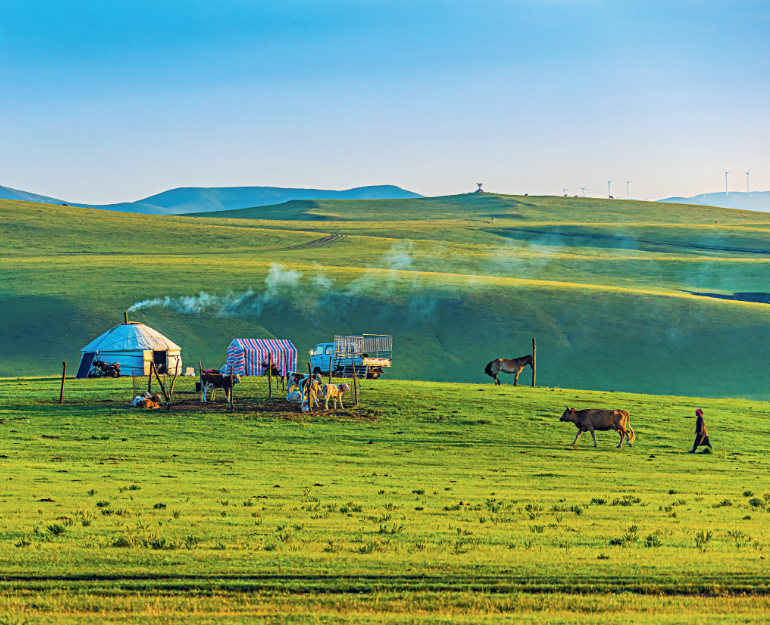
A peaceful morning for local herders. (LIU WENZHONG)
Ar Horqin is the birthplace of Chinese grassland nomadic culture and still observes the country’s most typical nomadic lifestyle. In May 2022, the Ar Horqin Grassland Nomadic System in Inner Mongolia was designated by the United Nations Food and Agriculture Organization (FAO) as a Globally Important Agricultural Heritage System (GIAHS). It is currently the only nomadic agricultural heritage site in China included in the GIAHS list.
Time-honored Nomadic Traditions
Before dawn, 55-year-old herder Chaienchaogetu joined his wife and son to prepare for the journey to the summer camp. He has traveled this 100-kilometer migration route for 41 years. “The summer pastures have been resting for more than half a year, so it’s time for it to ‘go to work,’” said Chaienchaogetu. Local herders understand that only through rotational grazing can the grasslands revive and rejuvenate. During the migration, continuous rain soaked through his shirt. “I like the rain so much,” he laughed. “More rainfall means the grass gets to drink enough water to grow taller, so the cattle and sheep grow fatter.”
The Ar Horqin Grassland Nomadic System is located in the farming-pastoral transitional zone of northern China. Bayanwenduer Sumu, core area of the system, covers a total area of about 3,333 square kilometers with a population of 14,883 in 5,657 herder households across 23 Gachas (villages). The time-honored traditions of nomadic life, migrating between the winter and summer pastures for water and foraging resources, have been well preserved there.
Each year on June 15, herders begin moving 128,000 livestock on a three-day journey, creating a spectacular scene. In mid-to-late September, they return to their winter camp with their livestock, where the animals are kept in pens and fed hay. Most herders rely on animal husbandry as their primary source of income. The close interdependence between herders, livestock, and grasslands (rivers) underpins the deep-rooted Mongolian philosophy of revering nature and harmonizing with it, while also nurturing a rich and distinctive nomadic culture.
In addition to the traditional Mongolian festival Naadam, the grassland is also home to three national intangible cultural heritages: Mongolian Khan Court Music, Mongolian Lele Cart Manufacturing Skills, and the Ariben Sumu Wedding Ceremony. It also hosts historical sites such as the ruins of Ligdan Khan’s palace in Chaganhot, Han Temple, and Genpi Temple. All of these places are important components of the Ar Horqin Grassland Nomadic System.
Prioritizing Grassland Conservation
Talinhua National Grassland Park is located in the core area of the Ar Horqin Grassland Nomadic System. The Talinhua Park Administration Center, established in 2021, also serves as the Ar Horqin Banner Agricultural Heritage Protection Center. “The grassland in Ar Horqin is exceptionally precious,” said Li Chengbin, director of the park administration center. “The core area spans about 667 square kilometers without a single fence post, stretching layer upon layer as far as the eye can see—it’s extremely beautiful. However, persistent droughts and extreme weather in recent years have left the grassland very fragile. The soil layer is thin, with sand just five centimeters beneath the surface. Therefore, grassland conservation and restoration are now a top priority of the administration center. This is the only way to effectively preserve our agricultural heritage, which in turn empowers development and ultimately benefits the herders.”
Grassland conservation efforts in Ar Horqin have been focused mainly on ecological restoration and livestock carrying capacity control.
Since 2020, Bayanwenduer Sumu has implemented an ecological restoration and grassland management project in the core nomadic area, covering a total of 6.27 square kilometers. The project involved 0.51 square kilometers of fencing and sand stabilization with mixed sowing of pasture grass and 5.76 square kilometers of fencing combined with aerial seeding.
Talinhua National Grassland Park carried out a wild pasture seed breeding project on the collective hay meadows within its territory. A total of 3.67 square kilometers of grassland were used as pasture seed breeding bases to cultivate crops such as false wheatgrass, Stipa grandis, and crested wheatgrass and meet the demand for high-quality pasture seeds suitable for the region’s ecological restoration and grassland management project.
Based on current observations, the wild pasture seed breeding project has gradually delivered ecological benefits alongside economic gains, according to Li. Vegetation coverage has significantly improved, with the height of pasture grass and hay yield per unit steadily increasing. Native plants such as leek and morning star lily now enjoy a sufficient population size, providing abundant food and habitats for insects, small mammals, and other wildlife. These efforts helped preserve local grassland biodiversity and contributed to a more stable and healthy grassland ecosystem.
To achieve a grass-livestock balance, the region has also formulated the Ar Horqin Grassland Nomadic System Protection and Development Plan, outlining a gradual reduction of livestock populations in the nomadic area until required standards are met. In 2022, Ar Horqin Banner refined its livestock carrying capacity. Based on grassland types and grazing seasons (warm and cold), the local natural pastures were divided into three regions, each with defined carrying capacity standards to enable targeted management.
According to Li, the population of nomadic livestock in the region peaked at 500,000 but has now been reduced to 128,000, achieving an initial grass-livestock balance. During the summer migration, Li and his colleagues would set up checkpoints along well-traveled routes to the nomadic areas to closely monitor the population size of livestock. “Herder families participating in the migration are required to apply for a grazing permit,” Li explained. “We conduct strict checks on the livestock and count the number of cattle and sheep. Only qualified families are allowed to enter the nomadic area. This year, we introduced an AI-supported automated monitoring system, which uses cameras to check the livestock with an accuracy rate of over 95 percent. It’s incredibly convenient.”
Attracting Young People Back Home
Like most rural areas, the Ar Horqin region is also grappling with the challenge of youth outmigration. Li Chengbin noted that the proportion of young people in the pastoral areas is very low, accounting for only one-fifth of the population. “Although the skies are blue, the grass is green, and the water is clear here, working with livestock every day is considered monotonous and unprofitable by young people,” he said. “Many have left for big cities. We hope to attract them back by establishing cooperatives to create large-scale breeding operations.”
The region has leveraged the pristine, pollution-free grazing conditions of the nomadic areas to build high-quality natural breeding bases for beef cattle and sheep. In 2021, an investment of 3 million yuan (US$422,000) was made to establish a traceability system and big data platform for cattle. Efforts have been focused on cultivating geographical indication brands Ar Horqin Beef and Ar Horqin Lamb. By deep processing or premium packaging of high-quality agricultural and livestock products, the added value of these products was increased, thus generating higher corporate revenues and benefits for herders.
In 2024, Bayanwenduer Sumu started constructing a breeding base for high-quality Angus beef cattle in an effort to develop a modern beef cattle industry. The overall goal is to introduce excellent breeding resources from abroad and cultivate commercial beef cattle populations. The base under construction plans to reproduce 10,000 Angus beef cattle in the next three to five years and build the Pure Ar Banner premium beef brand.
To create tourism job opportunities for young people, Talinhua National Grassland Park has conceived new nomadic culture-themed tourist projects. According to Li, activities such as following herders on the migration, making traditional dairy products, and riding the Lele Cart help visitors gain a better understanding of local culture through hands-on experience in the nomadic lifestyle. Designed for students and researchers, the forage study tour empowers visitors to observe pasture growth first-hand and learn about grassland ecology in the park’s pasture seed breeding bases. The park is also planning to collaborate with Gaogesitai Hanwula National Nature Reserve and Bayanwenduer Sumu on sightseeing route development to offer visitors a wider range of options.
The region has also been working on promoting a greater sense of cultural identity among the younger generation through diverse activities including ovoo (sacred cairn) ceremonies, the Naadam festival, exhibitions themed on nomadic culture, and grand launch ceremonies for the annual summer migration. Enhanced cohesion and greater cultural pride among young herders are poised to play an important role in maintaining the vitality of the Ar Horqin Grassland Nomadic System in the centuries to come.