On the tranquil waters of Xiaoshanyang, a small lake in Deqing County, Zhejiang Province, rows of white, spherical buoys are lined up in perfect order, resembling strands of pearl necklaces. Once a thousand-year-old pearl-farming site, this heritage-rich waterbody has emerged as a global benchmark for the preservation of agricultural heritage.
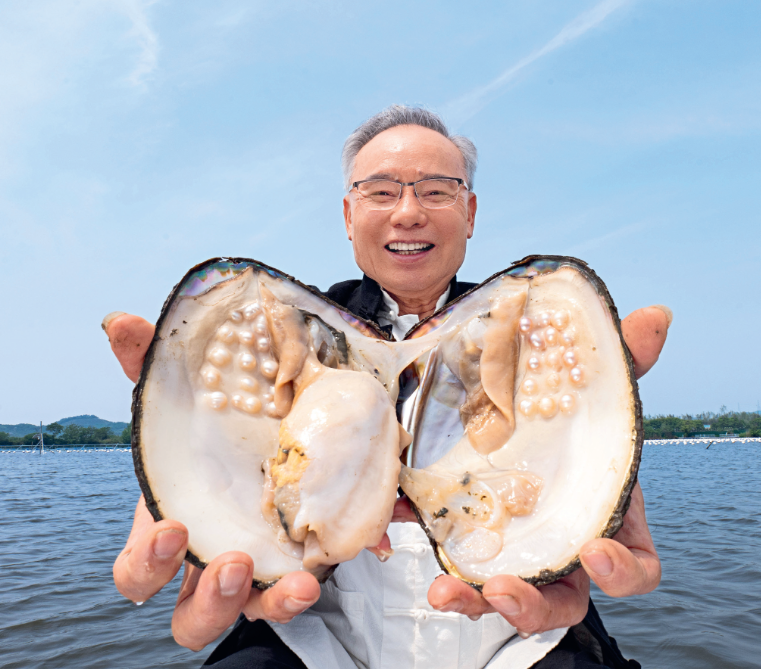
Shen Zhirong, known as the “pearl grandfather” of Deqing, demonstrates pearl harvesting by opening a mussel. (OSM)
On May 19, the Food and Agriculture Organization of the United Nations (FAO) officially recognized Deqing’s integrated freshwater pearl farming system as a Globally Important Agricultural Heritage System (GIAHS)—marking the first time an aquaculture-based project in China has received such a prestigious international designation. With its ecological significance, technological innovation, and deep cultural roots, the Deqing pearl system vividly demonstrates the enduring wisdom of China’s agricultural civilization to the world.
Roots of a Legacy
From a local folk practice to national recognition and eventually global acclaim, Deqing’s pearl-farming tradition has taken nearly half a century to be fully surveyed and acknowledged.
In 1979, Shen Zhirong, founder of Deqing-based pearl company OSM, visited Japan and learned that China was the earliest country to practice freshwater pearl farming. Upon returning home, he began searching widely for historical records to trace the origins of the craft. Through a comparative analysis of local gazetteers, archaeological findings, and the evolution of freshwater pearl farming techniques, Shen ultimately identified Deqing as the birthplace of China’s freshwater pearl cultivation.
As early as the Southern Song Dynasty (1127-1279), local artisan Ye Jinyang pioneered the technique of grafting blister pearls onto mussel shells, marking a breakthrough in freshwater pearl cultivation. This craft later spread via the Maritime Silk Road to countries across Eurasia, exerting a lasting influence on the global pearl industry.
Over time, Deqing developed an integrated pearl-farming model built on fish-mussel symbiosis: fish eat aquatic plants, mussels filter fish waste, and pearls form inside the mussels. This circular system uses resources efficiently and helps protect more than 10 mussel species and over 40 freshwater fish species. Its landscape features a patchwork of shallow pools, ponds, farmland, forests, and villages, offering a sustainable model for fisheries in river-network and delta regions.
In 2017, China’s Ministry of Agriculture and Rural Affairs recognized Deqing’s system as a Nationally Important Agricultural Heritage System. Later that year, Deqing began the process of applying for inscription on the Globally Important Agricultural Heritage Systems (GIAHS) list. In April 2025, FAO experts conducted field evaluations and confirmed its inscription.
The head of the expert panel noted that Deqing’s unique value lies in its complete preservation of a traditional aquaculture system and its integration with modern ecological agriculture. FAO expert Aicha Bammoun praised the Deqing pearl system for building a new bridge for China’s traditional agricultural wisdom to reach the global stage and serving as a model of heritage conservation.
From Pearls to Prosperity
Deqing’s pearl sector is more than a cultural treasure—it is a driver of local prosperity. Today, value-added processing totals nearly 100 tons a year—about 10 percent of China’s freshwater pearl output—generating an annual turnover exceeding 7 billion yuan (about US$1 billion).
“To keep agricultural heritage alive, we must support it with modern technology,” said Jiang Weifeng, deputy director-general of the Zhejiang Provincial Department of Agriculture and Rural Affairs. In recent years, Deqing has advanced an “industry + technology” approach that is powering the sector’s growth.
On the cultivation front, a new generation of pearl growers has refined the fish-mussel model through science-based, eco-friendly practices. By studying how water temperature, density, and mussel age affect pearl formation, they have developed full-process standards from nucleus insertion and mussel conditioning to co-culture ratios and cycle control. These efforts have produced better quality and higher yields, helping Deqing pearls stand out in the market.
As the leading enterprise in Deqing’s pearl industry, OSM applies modern technology to advance deep processing and raise added value. Only about 5 percent of farmed pearls are jewelry-grade. “To increase added value, OSM uses modern technologies to extract bioactive compounds from pearls for cosmetics, supplements, and pharmaceuticals,” said Yang Anquan, president of OSM Group. “This extends the value chain, enriches downstream products, and supports sustainable growth.”
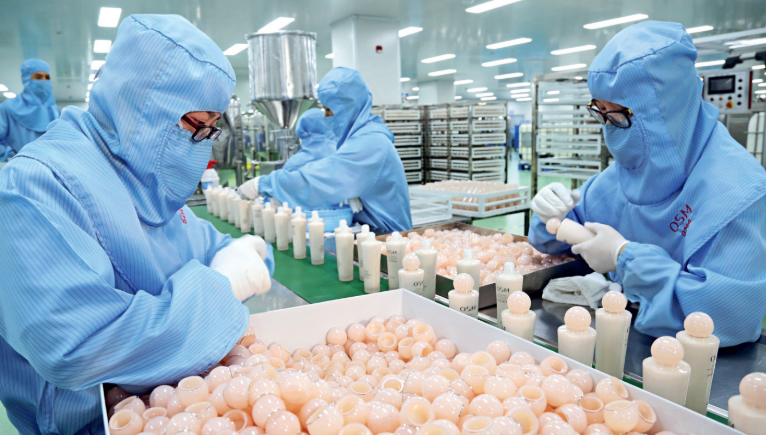
OSM’s manufacturing line for pearl-infused skincare products. (OSM)
OSM has also introduced a “5G+Industrial Internet” system covering raw-material screening, formula dosing, quality inspection, and warehousing, achieving end-to-end intelligent management. The digital system has shortened new-product R&D cycles by 31 percent and reduced defect rates by 24 percent.
Through technology and innovation, Deqing has navigated its pearl industry towards a high-tech, higher-value path, boosting local industry and raising farmer incomes. Nearly 3,000 people are directly employed in the sector, with over 20,000 jobs in related areas. Contract farming bases cover 433 hectares, supporting 5,083 households, each gaining more than 50,000 yuan (US$6,875) in additional income.
Building on a “pearl+” model, Deqing integrates farming, processing, R&D, and cultural tourism. The industry has expanded from single-purpose farming into cosmetics, health, and cultural tourism, forming an integrated framework that links production, research, and tourism.
Heritage as Opportunity
Yang, also secretary-general of the Deqing County Pearl Industry Association, was deeply involved in the GIAHS inscription process. “For us, heritage is not just an honor—it is an opportunity for growth,” he said. Over the past decade, OSM has invested nearly 200 million yuan (US$27.5 million) in heritage research, conservation, and public outreach.
The OSM Pearl Museum is a prime example. With over 6,000 square meters of floor space and about 150 million yuan (US$21 million) invested in exhibitions and displays, it has been a cultural landmark since 2017, drawing nearly 100,000 visitors annually.
The company has also launched an integrated breeding-cultivation-distribution program, establishing a germplasm bank for freshwater mussels to support live conservation, specimen preservation, and gene banking. It breeds improved mussel strains and distributes them to farmers, sustaining the industry’s long-term health.
On the cultural front, OSM has documented pearl-related folklore, traditions, and festivals as well as revived practices such as Ye Jinyang’s Buddha-image blister pearl technique. “The quality has improved, and these pearls have been embraced by consumers,” Yang said.
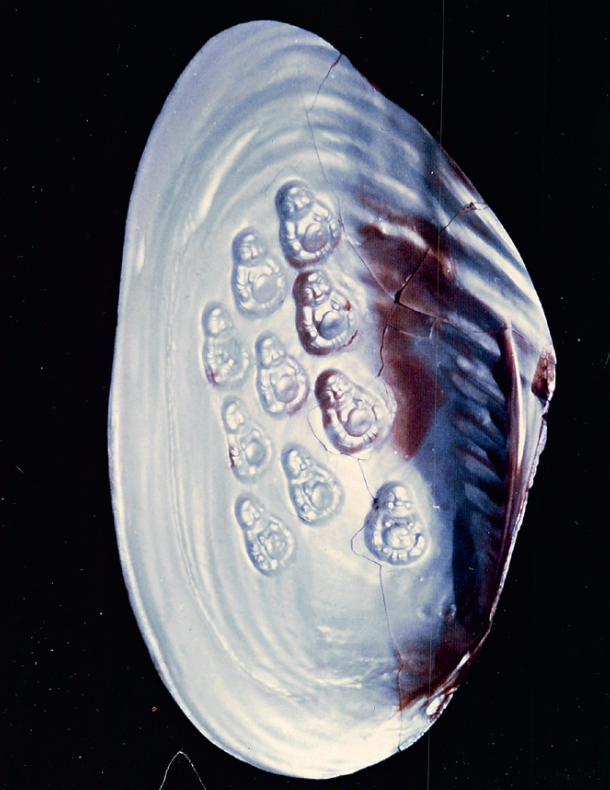
A blister pearl (Buddha-image pearl) cultivated with Ye Jinyang’s traditional pearl-farming technique. (OSM)
Safeguarding Agricultural Heritage
Deqing is accelerating work on a regional pearl brand identity and standards system, strengthening recognition of its GIAHS status. “Inscription is just the start,” said Min Qingwen, chair of the GIAHS Expert Committee under the Ministry of Agriculture and Rural Affairs. “We must continue to explore and communicate the system’s value.”
Yang noted that cultural research and outreach do not bring immediate profits and can strain enterprises. “In the long run, however, these investments drive the industry,” he said. “They will pay off and deliver ecological, economic, and cultural benefits—but companies cannot do them alone.” He called for stronger support from government, research institutions, and international organizations.
“The local government should increase investment in public branding and enact protective legislation, as seen in other agricultural heritage regions in China,” he continued. “It should also formulate long-term strategies to leverage heritage status and consolidate resources.
“We also need universities and experts to provide academic and technical guidance so that enterprises can better research, protect, and harness pearl-related culture.”
To improve international cooperation, Yang proposed using Deqing’s Farming Museum as a platform for showcasing GIAHS projects worldwide and as the permanent venue for a GIAHS academic forum that would bring together UN bodies and academia to advance the protection, inheritance, and utilization of agricultural heritage.