In May 2025, the Fuding White Tea Culture System in southeast China’s Fujian Province was officially recognized by the UN Food and Agriculture Organization (FAO) as a Globally Important Agricultural Heritage System (GIAHS). It mainly includes national-level superior varieties: Fuding Dabai Tea, Fuding Dahao Tea, and Fuding Cai Tea (group variety) which retains tradition and uses tea seeds for sexual reproduction, providing abundant germplasm resources for cultivating new tea varieties. The tea gardens adopt an ecological planting mode and a 3D landscape configuration, forming a “tea-tree-grass” composite ecosystem that effectively enhances the efficiency of resource utilization and pest and disease control.
In recent years, Fuding City has not only protected and inherited the white tea culture, but also actively explored the use of modern technology to drive industrial development.
Tea Gardens with Crops and Trees
White tea, one of the six major types of traditional Chinese tea, is a slightly fermented tea. It was so named because the buds and leaves of the tea trees are white, especially in spring, when the first bud with two leaves unfurls like white silver and snow. Fuding is the birthplace and core production area of white tea, with a history of more than 1,400 years of cultivation. As depicted in The Classic of Tea by Tang Dynasty poet and scholar Lu Yu (733-804), “A mountain of white tea can be found 300 li (150 km) east of Yongjia County.” According to research, the “mountain of white tea” refers to Taimu Mountain in Fuding. Surrounded by mountains on three sides and the sea on the other, this location is a golden production area for Chinese white tea.
In the tea gardens in Fuding, white tea trees are ingeniously interplanted with sweet potatoes, tangerines, and other crops, as well as osmanthus and hibiscus trees, creating an ecological scroll of tea gardens accented by crops and trees. The various crops and trees not only create a suitable environment for the tea trees with appropriate temperature and humidity, but also build a natural shield against diseases and pests through biodiversity.
Yang Yingjie, deputy director of the Fuding Municipal Office of the Leading Group for Tea Industry Development, said that based on the features of tea trees and other crops as well as the differences in their demands for light, heat, water, and fertilizer, local farmers have explored a sustainable 3D cultivation model of “single-node cutting (asexual reproduction of tea trees), sparse interplanting, combined light and heavy pruning with coppicing, and integrated physical and ecological pest control,” achieving a dynamic balance in the tea garden ecosystem. Single-node cutting can increase the survival rate of tea tree reproduction, ensure the purity of tea tree varieties, and reduce costs. Sparse interplanting can ensure light and ventilation and improve the quality of tea. Local farmers built ponds for collecting rainwater around tea gardens to be used for irrigation during the dry season. They have also covered the soil in the tea gardens with straw to reduce water evaporation, improve soil fertility, and enhance the sustainability of tea production.
Today, the tea gardens in Fuding have preserved not only 18 varieties of tea trees, but also over 120 agricultural species other than tea including 41 species of vegetables, 14 species of fruits, 11 breeds of domestic animals, 31 freshwater species, and 32 species of edible fungi, making a major contribution to enhancing the resilience of the ecological system.
During a discussion with representatives of the FAO last April, Lin Qing, secretary of the CPC Fuding Municipal Committee, declared that the city would continue to promote research on the conservation of white tea germplasm resources and cultivation and optimization of new varieties, promote the research plan “Fuding White Tea Germplasm Resources DNA Fingerprinting Map,” and accelerate the construction of the Fuding White Tea Gene Bank project.
Inheritance with Innovation
The processing and production procedures for white tea consist of only two steps: withering and drying. The lack of stir-frying and kneading retains the original flavor of the tea leaves to a large extent. Among the six major types of traditional Chinese tea, white tea has the fewest processing steps, but the technical hurdles remain very high. During the withering stage of Fuding White Tea, it takes 36 to 72 hours of continuous operation to dry fresh tea leaves to ensure the best taste and quality of tea.
“The technique for making white tea seems simple but is saturated with mystery,” said Lin Zhenchuan, a national-level inheritor of the intangible cultural heritage of Fuding White Tea. “Under different weather conditions and temperatures, the moisture content of tea leaves differs. Specific operations must differ accordingly. Good white tea requires rich experience and professional skills, with the right management and control of temperature, humidity, and time.”
The Fuding White Tea making technique was inscribed on China’s National Intangible Cultural Heritage List in 2011. In 2022, it was inscribed on UNESCO’s Representative List of Intangible Cultural Heritage of Humanity as part of the “Traditional Tea Processing Techniques and Associated Social Practices in China.”
In April 2025, Jose-Maria Garcia-Alvarez-Coque, chair of the FAO’s Scientific Advisory Group of the GIAHS program, said during a visit to Fuding that the Fuding White Tea Culture System is not only an agricultural system, but also an intangible cultural heritage. The elements of intangible cultural heritage are highly relevant to the concept of agricultural heritage.
Fuding is surrounded by mountains on three sides and the sea on the other, with a humid and rainy climate. The method of natural withering in traditional white tea production is highly dependent on weather conditions. Tea makers have to be flexible and adaptable according to the actual situation; hence the saying, “One should process tea according to the physical properties of tea leaves as well as the environmental conditions such as climate and season.”
This uncertainty makes it impossible to achieve mass production or meet the requirements of standardized production.
To solve that problem, Lin Zhenchuan has long been working with experts from the Fujian Agriculture and Forestry University to develop an automated production line for white tea withering using LED light sources. The system could achieve automatic temperature and humidity control, which is more precise than manual operation, with high production efficiency and stable quality.
“To advance the white tea industry, we must balance tradition with innovation,” said Lin, “While staying true to time-honored techniques, we can harness modern approaches to boost tea production, ensure consistent quality, and achieve standardization.”
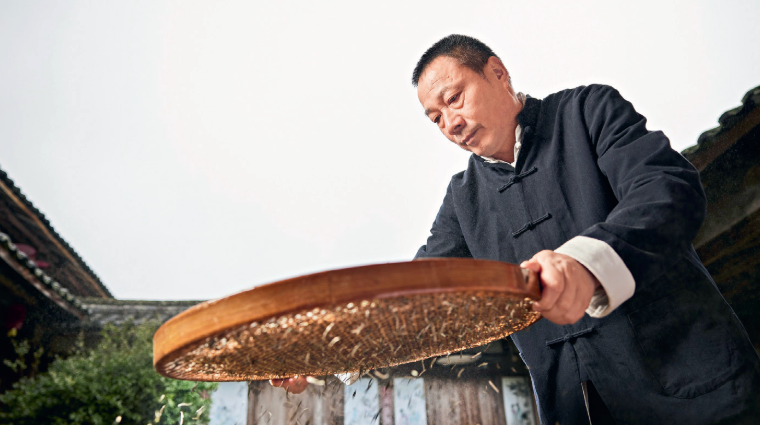
Lin Zhenchuan, an inheritor of the intangible cultural heritage of Fuding White Tea production techniques, is making tea.(PUBLICITY DEPARTMENT OF THE CPC FUDING MUNICIPAL COMMITTEE)
Jose-Maria noted that the Fuding White Tea Culture System can provide a reference for other countries. The system, which is patented locally, aligns with multiple sustainable development goals. “What impressed me most was the modern innovation based on traditional techniques, which has endowed the system with even greater vitality and vigor,” he said.
Full-Chain Traceability
Information technology has brought changes to Fuding’s white tea industry. In 2019, Fuding launched construction of a big data traceability system for white tea. Through satellite remote sensing and unmanned aerial vehicle mapping, the city has established a “digital archive” for 360,000 mu (24,000 ha) of tea gardens. Based on it, the local town and village officials double-checked relevant information such as acreage and variety of each household and publicized the information for comment before granting tea leaves trading quotas to each household. They have also integrated the information of tea farmers, tea companies, and tea brokers into the system and assigned an exclusive QR code for each. The entire transaction process is scanned to ensure that all the links from production to sales are clearly visible and traceable. Since 2021, all of Fuding White Tea products have been sold with QR codes. Consumers can scan the codes to learn all about the origin, processing, and circulation, achieving full-chain traceability from tea gardens to tea cups.
Zhang Qingbi, director of the Fuding Tea Industry Development Center, is a promoter of the big data traceability system for Fuding White Tea. “The system covers over 76,000 tea farmers, more than 1,600 tea brokers, and 3,137 tea companies throughout the city,” she said. “In 2024, the system intercepted 120 tons of substandard tea leaves, safeguarding the quality of white tea at the source.”
While empowering consumers to purchase with confidence, the data accumulated by the system has also provided a more solid basis for policy-making and accurate financing credit. Tea companies can arrange their production plans more scientifically and shift from “relying on experience” to “relying on data,” which has promoted transformation of the industry from scale expansion to quality improvement.
In response to demands from the young consumer group, Fuding tea companies have actively developed cold-brewed white tea, ready-to-drink tea, and other products for the new tea beverage market. They have also launched derivative products, such as white tea masks and tea extract skin care products, continuously extending the industrial chain. Through new channels such as short videos and live-streaming e-commerce, a new market has been cultivated for Fuding White Tea among the Gen Z consumers. Last year, the topic of Fuding White Tea on Douyin garnered over 5 billion views, with top influencers racking up more than 5 million yuan (US$705,000) of sales in a single live stream.
According to 2024 data, the current acreage of productive tea gardens in Fuding has reached 319,100 mu (21,275 ha), with an output of 21,000 tons of white tea. The comprehensive output value of the entire industrial chain has reached 15.51 billion yuan (US$2.15 billion), with products exported to 29 countries and regions. The tea industry has also driven the development of related local industries such as food processing, transportation, logistics, cultural tourism, catering, and hospitality. Of course, there is an old saying for that too: “One thriving industry can cause a hundred related industries to flourish.”