In a peach orchard in Lyuxiang Town, Jinshan District, Shanghai, youth delegates from 13 countries, officials from the Food and Agriculture Organization of the United Nations (FAO), and agricultural heritage experts were impressed by sweet and juicy Jinshan flat peaches.
Jinshan has a history of flat peach cultivation that spans hundreds of years dating back to the Yuan Dynasty (1271-1368). Today, the Jinshan flat peach is a local specialty, and Lyuxiang Town became a major fruit producer in Shanghai. The peach farmers have followed a set of agricultural practices for centuries. In 2023, the Jinshan Flat Peach Cultivation System in Shanghai was included in the seventh batch of China’s Nationally Important Agricultural Heritage Systems.
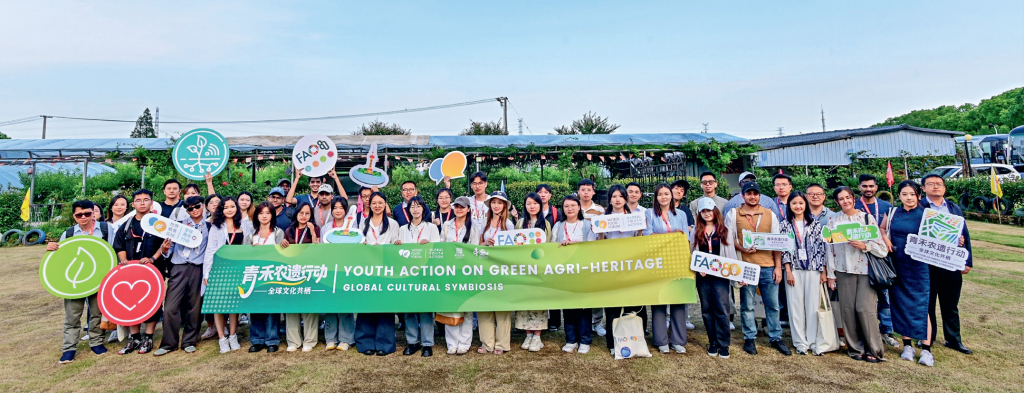 A group photo of youth representatives at the Youth Action on Green Agri Heritage: Global Cultural Symbiosis event.
New Vitality in Old Heritage
“Before this visit, I had no idea that Jinshan flat peaches are not only delicious but also have such a long history,” said Liu Yuanrui, a youth delegate from Tianjin University of China. “They are fresh evidence showing how the natural environment and humans co-evolved.”
“I’ve been to Shanghai more than 10 times, but this is my first exposure to the city’s agricultural heritage,” said Bae Hye-eun from the Republic of Korea. “This visit was a brand new experience.”
How has the Jinshan flat peach maintained its enduring appeal? How can continuous vitality be injected into time-honored agricultural practices? The modernization of peach cultivation in Jinshan provided an answer. For centuries, farmers in the region have preserved a tradition of growing “Shanghai Honey” peaches while developing the local planting industry centered on flat peaches and supplemented by economic crops.
In recent years, leveraging the national initiative on the construction of modern agro-industrial parks, Lyuxiang Town has launched an orchard renovation project aiming to build a demonstration base for high-standard agricultural production. Focused on result-oriented research, demonstration, and promotion of flat peach cultivation technology, efforts have been made in areas such as lowering the groundwater level, introducing new and premium flat peach varieties, improving soil quality, adopting new cultivation models, promoting standardized cultivation techniques, and using environmentally-friendly technologies in pest and disease control. Expert workstations have been established, pooling farming specialists and top experts on peach growing from across the country to equip local farmers with the latest techniques through field practice and classroom lectures. To enhance the added value of flat peaches, products like peach wine, freeze-dried peaches, and preserved peaches have been developed. Centered around festive activities such as the Flat Peach Festival, development of leisure agriculture and rural tourism in Jinshan has secured huge progress, transforming orchards into parks and production bases into scenic spots.
Farmer Gu Xiaohong, who cultivates over 130 acres of flat peaches, said that improving quality has resulted in brisk sales of peaches from her orchard. During the harvest season, Gu’s orchard receives groups of visitors and arranges agricultural activities for research or recreational purposes.
Agricultural cultural heritage has likewise benefited people in the rest of the world. “In my country, traditional practices such as using water hyacinths to build ‘floating gardens’ in floodplains, community seed banks preserving local varieties, and indigenous irrigation systems have been helping local communities for generations,” said Sakir Mohammad from Bangladesh.
“In Phongsaly Province of Laos, we have tea trees over 1,000 years old that are carefully protected by farmers,” said Sisavanh Senbounxou from the Faculty of Environmental Sciences at the National University of Laos. “In southern Laos, farmers dig fish ponds in their paddy fields, creating a miniature aquaculture system that helps both fish and rice grow.”
Gu Shijing, a Gen Z girl born in Xianju County, Zhejiang Province, shared her experience picking, eating, and selling waxberries with her family since childhood. In 2023, the Xianju Ancient Chinese Waxberry Composite System in Zhejiang Province was designated by the FAO as a Globally Important Agricultural Heritage System (GIAHS). “Each agricultural heritage system represents a unique repository of biological, cultural, and technological systems,” opined Gu. “Together, they form the cornerstone of human wisdom on addressing environmental challenges and ensuring food security.”
Youth Contributions
The idea of protecting the Jinshan Flat Peach Cultivation System aligns with the theme of the Youth Action on Green Agri-Heritage: Global Cultural Symbiosis event. After conducting in-depth research of agricultural heritage sites around the world, youth delegates attending the event provided solutions for the innovation of agricultural heritage systems.
Smart agriculture ideas such as green composite preservatives and modified atmosphere technology put forward by a Tongji University team helped fruit and vegetable growers in southern Jiangxi achieve deep processing of high value-added products. “Our team designed an adorable mascot named Orange Baby,” said team representative Zhou Qingyu. “We also developed well-received courses on popular science and spread agricultural knowledge in primary and secondary schools.”
Tianjin University’s Beiyang Love Relay team worked on a preservation project for the Danzhai rice-fish-duck symbiotic system, helping establish a digital database of farming processes. Through visual reality and gamified learning, they made farming accessible, interactive, and engaging.
A team from Mongolia shared an innovative approach to the development of Mongolian tea culture through which tea-derived products such as tea pillows and tea residue fertilizers are injecting new vitality into the traditional culture.
“I believe that young people can play a key role in protecting agricultural heritage, and I’m looking forward to international cooperation in this area,” said Maralmaa Tuvshin from the School of Public Health at the Mongolian National University of Medical Sciences.
“Youth are not just the inheritors and beneficiaries of agricultural heritage,” said Zhou Lijin, project officer of the FAO Representation in China. “Recognizing youth as drivers of change is key to promoting their engagement and employment in agri-food systems.” The Youth Action on Green Agri-Heritage: Global Cultural Symbiosis event encourages young participants to break conventions and discuss social, economic, and environmental issues in depth.
Pooling Global Efforts
Recently, Lyuxiang Town has been working on establishing a flat peach culture exhibition hall to deepen industry-university-research cooperation. “We are striving to open new pathways to develop agricultural tourism, with a goal of shifting from ‘selling products’ to ‘selling brands’ and ‘selling experiences,’” said a staffer from the Lyuxiang Town Agricultural and Rural Service Center. In 2024, the town was recognized as a national five-star site for rural tourism.
“China has demonstrated how agricultural systems keep up with technological progress,” said Sakir Mohammad. “Examples of smart agriculture and ecotourism show that tradition can also foster innovation. Bangladesh and China can share experience in areas such as sustainable rice cultivation technology, digitizing knowledge of traditional farming practices, and cultivating climate-resilient crops.” He added that when tradition and technology work together, agriculture can not only sustain development but also shape a resilient future for all humanity.
“Through this event, I learned that many young people have made earnest efforts to promote sustainable agriculture,” said Nigora Davronbekova from Tajikistan. “I think traditional agricultural practices can harmonize with modern technology to create more sustainable systems.”
“Preserving our agricultural heritage is not about choosing between traditional methods and new technologies but about how to bring them together,” said Sisavanh Senbounxou. “Technology enables us to document traditional farming practices, share them with the younger generation, and advance sustainable agriculture.”
“As we left the flat peach orchard, I looked out through the car window and wondered how many places like this exist around the world,” sighed Yasin Amara Sekou S Dra from Mali.
The story of the Jinshan flat peach is one of the best examples of China’s efforts to support agricultural heritage protection. Zeng Zixin, an assistant researcher at the International Project Office of the Center of International Cooperation Service of the Ministry of Agriculture and Rural Affairs of China, noted that after the FAO launched the GIAHS initiative in 2002, China became one of its earliest responders and a staunch supporter. As of August 2025, China has 25 GIAHS sites, ranking first in the world.