Youth representatives from 13 countries gathered in Jinshan Peach Orchard, where a local farmer introduced them to the centuries-old history of flat peach cultivation. Through their lenses, they documented a fusion of traditional wisdom and modern agricultural technology—a living narrative of agricultural progress that connects the past to the present.
On August 12, International Youth Day, the opening ceremony of “Youth Action on Green Agri-Heritage: Global Cultural Symbiosis” was held in Shanghai. Youth representatives and agricultural experts from 13 countries including Laos, Mongolia, South Korea, and Bangladesh came together to explore how to protect and revitalize agricultural heritage. The project, jointly initiated by the World Food Forum China (WFF China) and China Internet Information Center (CIIC) with support from the Food and Agriculture Organization of the United Nations (FAO) Representation in China and other organizations, aims to promote the preservation and sustainable development of global agricultural heritage through youth innovation.
“Youth are not merely the inheritors and beneficiaries of agricultural heritage,” remarked Zhou Lijin, a project officer from the FAO Representation in China, at the opening ceremony. “They are drivers of change.”
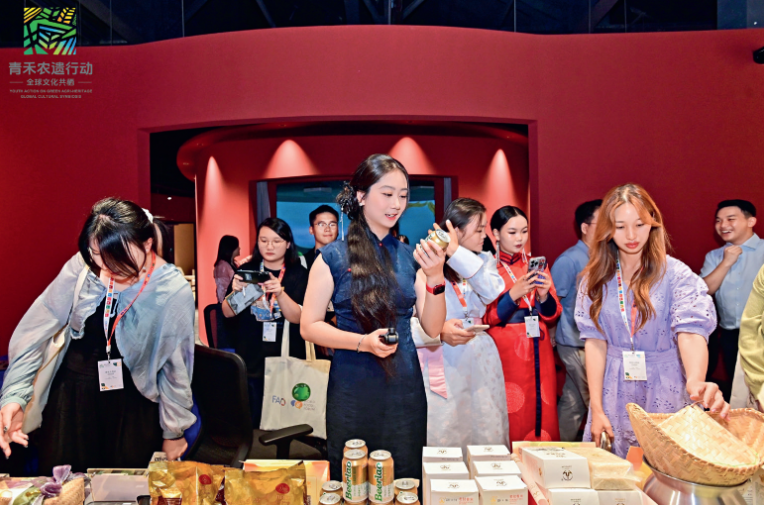 Internationalyouth representatives visit the Laos Economic and Trade Cooperation Expo in Shanghai’s Yangpu District. (CHINA.ORG.CN)
Eastern Philosophy on Agricultural Heritage Conservation
China has made remarkable achievements in preserving agricultural cultural heritage. After the FAO launched the Globally Important Agricultural Heritage Systems (GIAHS) initiative in 2002, China became one of its first responders, a staunch supporter, a successful practitioner, a key promoter, and a major contributor. As of August 2025, China has 25 GIAHS sites, ranking first in the world, according to Zeng Zixin from the Center of International Cooperation Service (CICOS) of the Ministry of Agriculture and Rural Affairs.
By adopting a philosophy of “preserving agricultural heritage by integrating it into modern development,” China has been endeavoring to explore and transform the economic, social, cultural, ecological, and scientific values of agricultural cultural heritage into a powerful resource for rural revitalization.
A prime example featured during the “Youth Action on Green Agri-Heritage” event was Shanghai’s Jinshan Flat Peach Cultivation System. With a history dating to the Yuan Dynasty (1279-1368), Jinshan flat peach cultivation was designated a Nationally Important Agricultural Heritage in 2023. For centuries, local farmers have refined the tradition of “Shanghai Honey” peach growing, innovating to create an integrated cultivation system centered on flat peaches alongside complementary cash crops.
Inspired by his visit to Jinshan Peach Orchard, Yasin Amara Sekou S DRA, a doctoral student from Mali, composed a poem to capture the beauty of the orchard and express the admiration shared by international youth for China’s agricultural cultural heritage.
The event also showcased agricultural heritage conservation practices from other countries.
The youth representatives also visited the Laos Economic and Trade Cooperation Expo in Shanghai’s Yangpu District to gain firsthand insight into Laos’ specialty agricultural products and achievements in green agricultural development as well as China-Laos exchange and cooperation in agricultural heritage conservation and sustainable development. The exhibition hall serves not only as a window to economic and trade cooperation between China and Laos, but also as a platform for promoting international dissemination of agricultural cultural heritage, facilitating sustainable agricultural technology exchange, and fostering youth innovation.
Ancient Wisdom, Modern Tools
The “Youth Action on Green Agri-Heritage” initiative recognizes technology and innovation as vital forces in preserving agricultural cultural heritage. Youth representatives were asked to conduct field research and film documentaries in Jinshan Peach Orchard and Jinshanzui Fishing Village, both part of Shanghai’s Jinshan Flat Peach Cultivation System. These efforts aimed to revitalize agricultural wisdom through modern technology and artistic expression.
Imaging technology is now a crucial tool for documenting and promoting agricultural heritage. Renowned Japanese director Takeuchi Ryo hosted the Youth Action on Green Agri-Heritage: Visual Creation Workshop, sharing insights on cross-cultural documentary filmmaking with the international youth delegates. He encouraged young people to leverage their unique perspectives to interpret China’s agricultural wisdom and breathe new life into agricultural heritage preservation through cross-cultural dialogue and exchange.
Digital technology is opening new frontiers in heritage preservation. Tianjin University’s “Beiyang Love Relay” volunteer team has helped preserve the Rice-Fish-Duck Symbiotic System in Danzhai, Guizhou Province, by creating a digital database of farming processes. Through VR and gamified learning, they are making traditional farming methods interactive, engaging, and accessible to all.
Zhou Qingyu, a student from Shanghai-based Tongji University, remarked that the sustainability of agricultural heritage hinges on its fusion with technology. She saw the event as a chance to spark new ideas among students from diverse academic backgrounds and generate innovative, interdisciplinary solutions for heritage protection.
Harnessing Youth Creativity
The “Youth Action on Green Agri-Heritage” initiative was designed to ignite the creative and innovative potential of youth. On August 12, young people from 10 Chinese universities joined teams from Laos and Mongolia to share groundbreaking solutions based on the agricultural heritage sites they had researched. Their projects, spanning technological empowerment, cultural dissemination, and industrial development, demonstrated the younger generation’s innovative ideas and practical action for agricultural heritage preservation.
Wu Yuhui, a student from Nanjing University of Posts and Telecommunications, presented creative solutions for preserving the traditional stacked farming system in Xinghua, Jiangsu Province. Originating in the Southern Song Dynasty (1127-1279), Xinghua’s stacked fields represent a distinctive form of farmland. Wu and his team proposed leveraging digital technology to document and highlight the historical evolution, ecological value, and cultural significance of stacked fields while developing experiential tourism projects to involve more people in their preservation. By integrating traditional culture with modern industries, this approach provides fresh perspectives for the sustainable development of agricultural cultural heritage.
Youth representatives from other countries also shared their nations’ approaches to preserving agricultural heritage. Sakir Mohammad from Bangladesh highlighted time-honored practices that have sustained communities for generations including “floating gardens” built with water hyacinths in flood-prone areas, community seed banks to safeguard local crop varieties, and indigenous irrigation systems. Sisavanh Senbounxou from the Faculty of Environmental Sciences at the National University of Laos offered insights into the centuries-old tradition of ancient tea cultivation in his hometown.
“Everything we have in human civilization can be traced back to agriculture,” Sakir Mohammad declared. “Food is the most fundamental human need. This event provides a vital platform for young people to reflect on agriculture and our role in sustainable development.”
Commenting on the initiative’s significance, Chanthalath Pongmala, Assistant Country Representative at the FAO Representation in Laos, said, “It enabled participants to harness their innovative ideas, practical energy, and profound understanding of both tradition and modern transformation.”
The “Youth Action on Green Agri-Heritage” will continue with events on Jeju Island (ROK), in Vientiane (Laos), in Rome (Italy), and other locations. The gatherings will showcase outcomes of youth-driven innovations in agricultural heritage and welcome participation from UN agencies, government agricultural departments, media outlets, experts, and youth representatives from around the world. This cross-border collaboration network is set to become a broader platform for global agricultural heritage protection, fostering sharing of best practices and innovative cooperation across diverse cultures.